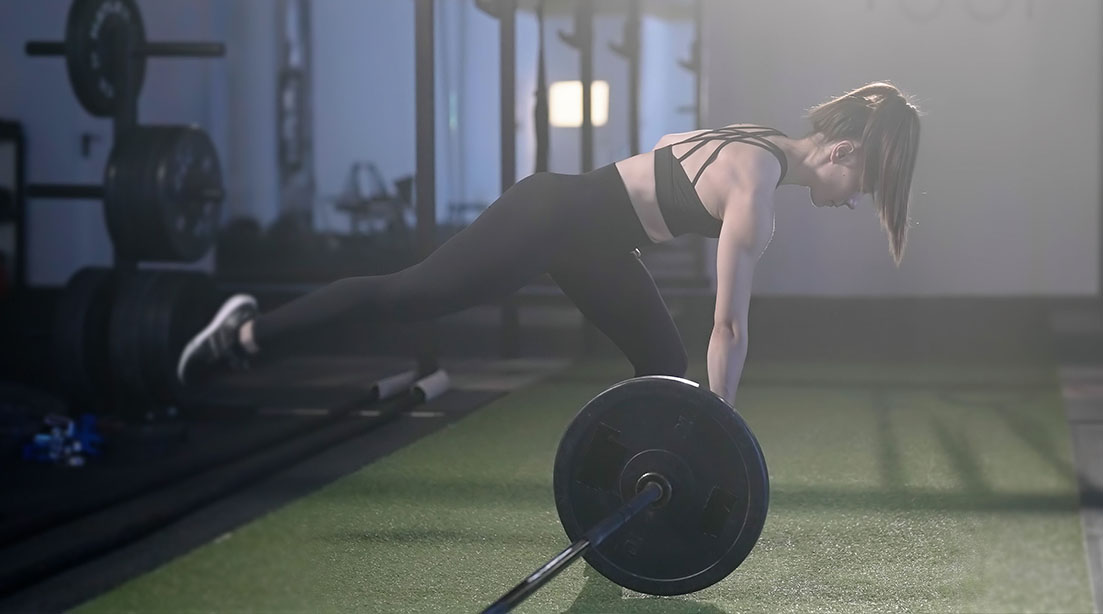
Assisted Single-Leg RDL: The Finest Hamstring Train for Power, Steadiness, and Damage Prevention
Unilateral workouts just like the single-leg Romanian Deadlift—aka the RDL— scale back muscle imbalances, strengthen stabilizer muscle groups, and improve muscle improvement. However there are some drawbacks to a majority of these strikes—the most important probably being the inevitable wobbles. When you go heavy, combating to remain upright oftentimes grow to be a much bigger problem than constructing muscle.
The repair, nonetheless, is straightforward: By holding a safe anchor, you’ll take the awkwardness out the train. Including stability will drive extra motion to the working muscle.
That’s the considering behind the assisted single-leg RDL. By holding onto a rack or wall for mild assist, you take away stability because the limiting issue—it’s additionally not thought-about dishonest—and shift the main target again the place it belongs: your glutes and hamstrings. It transforms what was as soon as a circus trick right into a energy motion that exposes asymmetries and builds posterior-chain sturdiness from the bottom up.
If you need stronger hamstrings, cleaner deadlifts, and fewer “why does that facet really feel bizarre?” moments, this transfer deserves a spot in your exercise rotation.
What Is the Assisted Single-Leg RDL?
The assisted single-leg RDL is a unilateral hip hinge carried out with mild exterior assist for stability. It’s carried out with a dumbbell or kettlebell held within the reverse hand to the working leg (a contralateral load), which will increase hip stability and core engagement. In contrast to the normal variation, which regularly turns into a balancing act, the assisted model eliminates the wobble, permitting you to give attention to loading your hips and hamstrings.
By holding onto a rack, wall, or dowel along with your free hand, you acquire sufficient stability to keep up a great place and constant rigidity within the working hamstring. Meaning extra high quality reps, higher muscle recruitment, and fewer wasted power making an attempt to not tip over.
Find out how to Do the Assisted Single-Leg Romanian Deadlift Appropriately
Setup:
- Stand facet on to a squat rack or wall.
- Maintain a dumbbell or kettlebell within the hand reverse your working leg.
- Place your free hand calmly on the rack or wall.
- Maintain a tender bend within the working knee and brace your core.
Execution:
- Shift your weight into the working foot and root it to the ground.
- Hinge on the hips by pushing them straight again, feeling your hamstrings lengthening.
- Let your non-working leg prolong behind you as a counterbalance.
- Maintain your hips sq. and your backbone impartial.
- Decrease till you’re feeling a powerful stretch in your hamstring.
- Drive via your foot and squeeze your glute to return to the beginning place.
Full all reps on one facet earlier than switching.
Frequent Single-Leg RDL Errors (And Fixes)
Simply since you’re holding on to one thing doesn’t imply all the shape points go away. Right here’s what to look out for earlier than it turns into a difficulty.
Hips rotating open
As you hinge, the non-working hip rotates open towards the ceiling, decreasing hamstring rigidity and shifting weight onto the hip joint, reasonably than the muscle.
The Repair: Maintain your hips sq.. Think about your hip bones are headlights pointing straight on the flooring. If one “headlight” factors upward, reset and decelerate. If it’s nonetheless a difficulty after this cue, scale back the vary of movement to cease it from taking place.
Rounding the Decrease Again
Dropping impartial backbone shifts rigidity from the hamstrings and glutes to the lumbar backbone.
The Repair: Preserve a protracted backbone. Assume “chest proud, ribs down.” Hinge from the hips and really feel your hamstrings lengthen.
Extreme Knee Bend
Turning the hinge right into a squat reduces the hamstring stretch and shifts the emphasis to the quads. It’s not horrible, nevertheless it’s not the purpose of this train.
The Repair: Maintain a tender bend within the knee, then freeze it. Push the hips again, not down.
Utilizing Too A lot Higher-Physique Help
Gripping and yanking off the rack makes the motion simpler and reduces the strain on the working leg.
The Repair: Use solely mild fingertip contact. The hand is there for stability, not help. In the event you can’t do it with out pulling, scale back the load.
Advantages of Single-Leg RDL Advantages
Unilateral coaching is usually an afterthought due to the lighter load and the ego hit that comes with it. However this train fixes that and extra.
Exposes & Reduces Power Imbalances
Bilateral RDLs cover asymmetries. One hip shifts, one hamstring works more durable, and also you don’t discover till one thing hurts. The assisted single-leg RDL requires all sides to drag its personal weight. The result’s higher symmetry, cleaner mechanics, and stronger lower-body lifts throughout the board.
Trains The True Hip Hinge
As a result of stability isn’t the principle problem, you possibly can give attention to the hip hinge whereas conserving the backbone impartial. That reinforces correct hinge mechanics that carry over to deadlifts and kettlebell swings.
Builds Hamstring Power
The assisted single-leg RDL masses the hamstrings in a stretched place, a key think about constructing energy and damage resilience. Robust hamstrings at lengthy lengths strengthen your brakes, that are crucial for damage prevention, particularly throughout sprinting and change-of-direction work.
Hip Stability Growth
Single-leg hinges problem your capacity to maintain the pelvis degree. They mild up the glute medius and enhance lateral hip stability, which is important for knee well being and enhanced lower-body efficiency.
Programming Options
This train is finest positioned as an adjunct train after your greater bilateral actions, because you need to save your power for heavier masses. The next are basic suggestions, relying in your objective.
For Power:
- 3–4 units of 6–8 reps per leg
- Use a moderate-to-heavy dumbbell or kettlebell
- Concentrate on managed eccentrics
- Relaxation 90 seconds between legs
For Muscle:
- 3 units of 12 reps per leg
- Use a 3-second eccentric to extend time underneath rigidity
- Add a quick pause on the backside to eradicate momentum
- Relaxation 2 minutes between units.
Deadlift Accent:
- 2–3 units of 8–10 reps per leg
- Carry out after bilateral RDLs, lure bar deadlifts, or typical pulls with a reasonable to heavy load
- Prioritize eccentric, pauses, and highly effective lockout
- Relaxation 30 seconds between legs and a pair of minutes after every set.
